Alphabet’s Negative Free Cash Flow and AI CapEx Surge: The Semiconductor Spending Paradox
Alphabet’s negative quarterly free cash flow is not evidence that its operating business stopped generating money. It is evidence that infrastructure investment overtook that cash generation. For semiconductor suppliers, the same spending that squeezes Alphabet’s near-term cash flow can create substantial revenue opportunities.

That is the paradox: financial pressure at the customer can initially look like prosperity across its supply chain.
In the second quarter of 2026, Alphabet generated $39.069 billion in operating cash flow and spent $44.924 billion on capital expenditures, leaving negative free cash flow of $5.855 billion. Trailing-twelve-month free cash flow remained positive at $53.273 billion. The quarterly deficit and the longer-term cash position tell different, equally important stories.
The central question is not whether spending is large. It is whether the assets being purchased will generate enough future cash to justify their cost—and whether suppliers can sustain today’s growth while that economic test unfolds.
The Cash-Flow Statement Explains the Headline
Alphabet defines free cash flow as operating cash flow minus capital expenditures.
That makes the second-quarter result straightforward: the company generated substantial cash from operations, then invested more than that amount in property and equipment.
Negative free cash flow is therefore not interchangeable with an operating loss, a liquidity crisis, or insolvency.
It can reflect an investment program whose cash payments arrive before its full commercial benefits. But that explanation does not make the deficit irrelevant.
Money committed to infrastructure is no longer available for other purposes. If expenditure repeatedly exceeds internally generated cash, the company must rely on financial reserves, external capital, or adjustments elsewhere.
The distinction is between financial capacity and investment quality. Alphabet can have the capacity to spend while investors still question whether it should spend at the proposed pace.
Where the Capital Expenditure Is Going
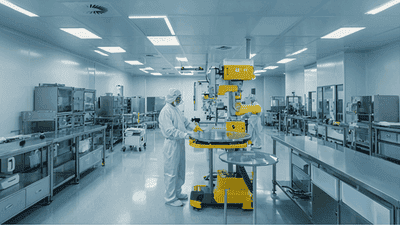
Alphabet said the vast majority of its second-quarter capital expenditure supported technical infrastructure for AI. Within that infrastructure spending, approximately 60% went to servers and 40% to data centers and networking equipment. Management raised full-year 2026 capital-expenditure guidance to $195–205 billion, from $180–190 billion. Those annual figures were guidance, not completed spending.
The composition matters because not every dollar becomes semiconductor revenue.
Servers contain processors, memory, networking components, storage, boards, power supplies, and other hardware. Data center expenditure includes facilities and supporting systems. Networking combines semiconductors with equipment, optics, software, and installation.
Multiplying Alphabet’s total budget by an assumed chip share would therefore produce a rough scenario, not a disclosed procurement figure.
The investment clearly supports semiconductor demand. Its precise distribution requires more detail than the headline provides.
The Supplier Gets Paid Before the Customer Gets the Return
A semiconductor supplier can recognize revenue when products are delivered under the applicable accounting terms. Alphabet may need to install those products, connect power, configure systems, and attract workloads before earning the intended return.
This creates a timing mismatch.
The supplier’s sale can be commercially successful even while the customer’s investment remains economically unproven.
That does not imply the spending is wasteful. It means the two companies occupy different stages of the cash-flow chain.
For investors, this distinction helps explain why chip earnings can strengthen while a hyperscaler’s free cash flow weakens. The equipment purchase is an immediate transaction for one party and a long-duration investment for the other.
Eventually, however, those economics reconnect. Sustainable supplier demand depends on customers continuing to find value in the infrastructure they purchase.
GPUs, TPUs, and the Redistribution of Chip Spending

Alphabet’s infrastructure strategy includes both externally supplied accelerators and its own Tensor Processing Units.
Custom silicon changes how the spending is distributed. It does not eliminate the semiconductor supply chain.
A proprietary accelerator still requires manufacturing, memory, packaging, testing, and supporting connectivity. Some value shifts away from an external branded processor supplier toward internal design and other production partners.
The strategic attraction is greater control over performance, costs, and workload optimization.
But custom hardware also introduces development commitments and execution risk. Its economic advantage depends on software, deployment scale, and actual utilization—not merely on owning the design.
For semiconductor analysis, the right question is which capabilities remain necessary across both purchased and internally designed compute platforms.
Interest Rates Raise the Standard for Future Returns
Infrastructure spending commits cash today in exchange for benefits expected over several years.
Higher interest rates make those future benefits less valuable in present terms and raise the return investors require.
That matters even when a company can finance investment from operating cash flow. Internal funding is not economically free; it has alternative uses.
For Alphabet, higher required returns increase the importance of productive utilization, durable demand, and disciplined cost control.
They can also affect customers buying cloud services. A business facing tighter financing conditions may reconsider an expansion project or adopt technology more selectively.
The rate channel therefore reaches both sides of the investment: the cost of building capacity and the willingness of customers to pay for its use.
Strong technology demand does not remove that financial hurdle.
Credit Turns a Cash-Flow Gap Into a Financing Question

A single quarter of negative free cash flow does not establish dependence on debt. Alphabet’s positive trailing-twelve-month figure makes that clear.
Nevertheless, sustained high investment creates a financing question: how will the company cover expenditure while preserving flexibility?
The answer can involve operating cash generation, reserves, external financing, or changes in capital allocation.
Each option has trade-offs. Drawing down reserves reduces the cushion available for setbacks. Debt introduces interest and repayment obligations. Equity changes ownership economics. Reduced shareholder distributions alter the investment proposition.
A credit analyst focuses on endurance rather than the excitement of the growth opportunity.
Can the company absorb slower monetization, construction delays, or higher operating costs without undermining its financial position? The answer requires a balance-sheet assessment, not just a free-cash-flow headline.
Currency Movements Reach the Budget Through Multiple Doors
Alphabet operates internationally and buys from a global technology supply chain.
A stronger dollar can reduce the translated value of some foreign revenue while potentially lowering the dollar cost of certain foreign-currency purchases.
But equipment contracts are not determined solely by where a supplier is located. Invoicing currencies, hedging, imported components, and payment schedules all matter.
The same currency move can help procurement and hurt reported revenue.
For suppliers, weaker domestic currencies may improve translated export earnings while increasing imported equipment or material costs.
This makes exchange rates relevant to both the customer’s investment budget and the supplier’s margin.
The proper analysis follows actual exposures. A simple dollar-up or dollar-down narrative is insufficient for a cross-border infrastructure program.
Power and Commodities Can Delay the Payoff
The semiconductor industry can deliver hardware faster than the surrounding infrastructure becomes ready.
Data centers need electricity, cooling, buildings, electrical equipment, and dependable supporting services. Construction and operating costs connect the investment to energy and materials markets.
Higher input prices can raise the budget. Limited availability can postpone commissioning.
The financial consequence is especially important: capital may already be spent while revenue-producing capacity remains unavailable.
That extends the period between cash outflow and return.
Commodity exposure should therefore be considered alongside scheduling and reliability. A modest price increase may be manageable; a delayed power connection can be far more disruptive.
The AI investment thesis ultimately depends on complete operating systems, not simply on chips arriving at a loading dock.
Depreciation Moves the Pressure Into Future Earnings
Capital expenditure affects cash immediately, while the cost of long-lived assets generally enters reported earnings over time through depreciation.
That can create a period in which cash-flow pressure is more visible than the full expense burden.
As assets enter service, depreciation and operating costs become increasingly important to profitability.
Alphabet’s investment discussion highlighted the continuing pressure from technical-infrastructure spending. Its economics must therefore be evaluated over the assets’ useful lives, not only during the procurement quarter.
The useful-life assumption matters, but so does actual competitiveness. Equipment can remain physically functional while becoming less attractive for demanding workloads.
Investors should distinguish accounting expense schedules from the economic pace at which hardware loses value.
Utilization Is the Bridge Between Spending and Value
A server does not produce an attractive return merely because it is installed.
It needs useful work, appropriate pricing, and manageable operating costs.
For cloud capacity, that involves customer demand. For internally deployed AI, the benefit may appear through product improvement, efficiency, or stronger existing services rather than a separately labeled revenue line.
Both routes can create value, but their measurement differs.
This is why broad statements about AI adoption are not enough to validate the investment. The financial question concerns incremental benefit relative to incremental cost.
Higher utilization can improve the economics of a large fixed-cost infrastructure base. Low utilization can leave depreciation, power, and financing costs weighing on returns even when the technology itself works.
What the Paradox Means for Semiconductor Investors
Alphabet’s negative quarterly free cash flow is neither automatically bearish nor automatically bullish for chip suppliers.
The near-term interpretation can be positive: substantial purchases support revenue across compute, memory, networking, and manufacturing services.
The longer-term interpretation depends on whether Alphabet monetizes those assets successfully.
If returns strengthen, investment can continue on a healthier financial basis. If monetization disappoints, spending growth may slow, procurement priorities may change, or efficiency become more important than maximum expansion.
Suppliers would then experience different effects depending on their products and customer concentration.
The essential principle is conversion: customer spending must eventually convert into customer value if supplier growth is to remain durable.
A Better Scorecard Than Free Cash Flow Alone
The quarterly deficit becomes more informative when combined with other evidence:
- Operating cash generation relative to capital expenditure.
- Deployment schedules and infrastructure readiness.
- Utilization and the value generated by installed capacity.
- Depreciation and ongoing operating expenses.
- Funding requirements and financial flexibility.
- Supplier orders relative to eventual customer consumption.
These measures distinguish a productive investment phase from an increasingly expensive commitment.
They also prevent the opposite mistake: treating every cash-flow decline as business deterioration when the expenditure may create valuable future assets.
The challenge is to test that possibility rather than assume it.
The Spending Paradox Has an Expiration Date
Alphabet’s second-quarter cash-flow deficit captured the scale and timing of its AI infrastructure investment. The company still generated substantial operating cash and positive trailing-twelve-month free cash flow.
For semiconductor suppliers, the spending creates a meaningful demand opportunity. For Alphabet shareholders, it creates a higher burden of proof.
Interest rates raise the hurdle, credit determines flexibility, currencies redistribute costs, and power availability governs deployment.
The paradox can persist while infrastructure is being built. It cannot permanently separate supplier prosperity from customer economics.
The decisive outcome will be whether today’s cash outflow becomes tomorrow’s durable cash generation. Until then, the strongest semiconductor thesis follows not only the purchase order, but also the customer’s eventual return.